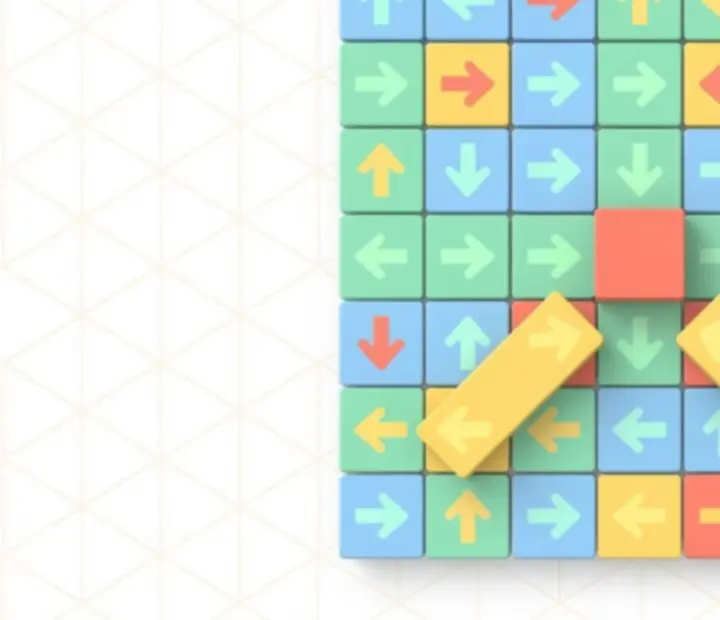
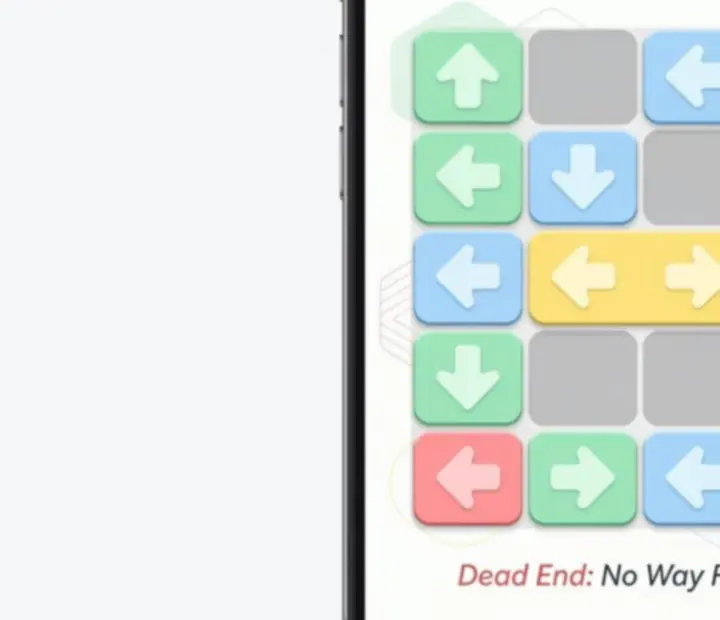
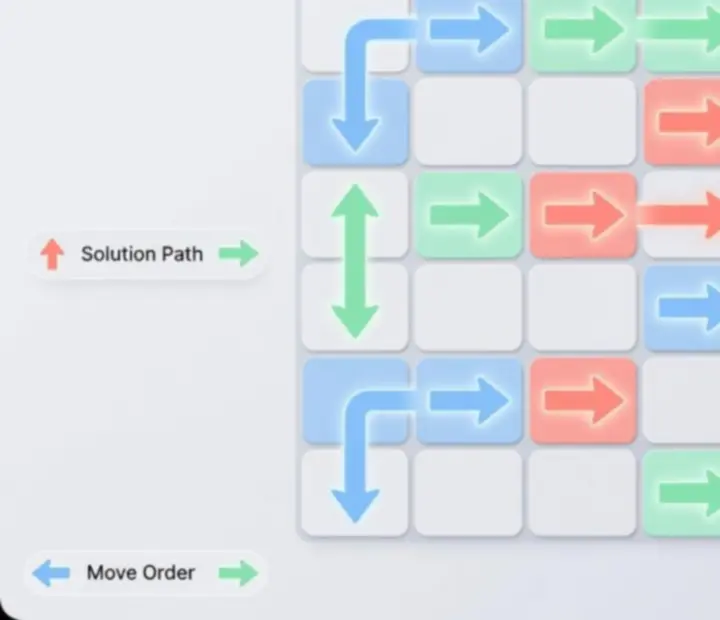
Deepen your understanding of Arrow Tap: Escape Puzzle with focused guides on blocked arrows, move planning, and advanced board-reading skills. Every section is built to help you turn tricky arrow grids into a calm, logical flow.
Arrow Tap: Escape Puzzle is all about reading which arrows are blocking others, choosing a safe first tap, and clearing the grid without boxing yourself in. These guides focus on the decisions that matter most.
Identify blocking chains
Sequence taps efficiently
Spot dead ends early
Scan complex layouts
Refine your intuition
Use these articles alongside the main How to Play and Tips & Strategy pages to build a relaxed but sharp approach to every board.
Guides & articles
Browse focused breakdowns of key situations you will face in Arrow Tap: Escape Puzzle, from the first blocked arrow you meet to late-game boards packed with overlapping paths.
Guide 01 · Blocked arrow logic
How to Solve Blocked Arrow Puzzles
Blocked arrows are the heart of Arrow Tap: Escape Puzzle. Each one either protects a future path or prevents current progress, so understanding who is blocking whom is essential before you tap anything.
1. Trace the flow of each arrow
Start by mentally extending the direction of each arrow until it reaches the edge of the board or another piece. Any arrow that immediately collides with another arrow is blocked; the one in front is being blocked, and the one behind is doing the blocking.
2. Identify primary blockers
Look for arrows that block several others at once. Clearing a primary blocker often unlocks multiple new paths, giving you far more freedom for later moves than removing an isolated piece.
Mark arrows that sit directly in front of two or more others.
Note which directions they are preventing (for example, a right-facing blocker in front of two right-facing arrows).
Prioritize these for early removal if it does not trap remaining arrows.
3. Test the impact of clearing a candidate arrow
Before tapping, quickly imagine the board without that arrow. Ask yourself which lines would become free and whether any remaining arrows would become permanently stuck behind new blockers.
4. Chain unlocks instead of single fixes
A strong move is one that turns a locked cluster into a chain reaction of new options. Choose taps that free a path for at least one other useful arrow, keeping the puzzle feeling fluid and relaxed instead of cramped.
Guide 02 · Sequencing moves
Planning the Correct Move Order
In Arrow Tap: Escape Puzzle, the order of your taps is often more important than the pieces you eventually clear. A good sequence keeps the board open and forgiving, while a rushed tap can quietly remove the only arrow that could unlock a cluster later.
1. Start from the exits, not the centre
Scan from the outer edges of the board inward. Arrows on the outside often define escape routes for those in the middle; clearing an inner arrow too early can cut off paths that still rely on an edge piece.
2. Reserve structural arrows
Some arrows act like structural beams: they keep several paths viable at once. If removing one arrow would force three others into blocking positions, postpone that tap until you have used its path as much as possible.
3. Ask “what does this tap close?”
Before each move, imagine the lines that will disappear along with the arrow. If it closes more options than it opens, it is usually the wrong move to make now—even if it looks tempting.
4. Sequence from low-risk to high-impact
Begin with taps that clearly free new paths without trapping anything, then progress to riskier moves once the board has been thinned out and is easier to read. This layered approach keeps mistakes manageable and the experience calm.
When in doubt, slow down: briefly simulate the next two or three taps in your head. Those few seconds of planning quickly pay off in smoother clears.
Guide 03 · Staying out of traps
Avoiding Dead Ends
Dead ends happen when the remaining arrows cannot reach an exit without colliding with each other. Learning to see these traps ahead of time keeps Arrow Tap: Escape Puzzle feeling smooth and restorative instead of frustrating.
1. Watch for single-path dependencies
If an arrow has only one possible escape line, treat both the arrow and that line as fragile. Avoid placing new blockers across that path until you are ready to clear the arrow that depends on it.
2. Spot enclosed regions
Groups of arrows that all face into each other form enclosed regions. Once you remove a key exit from that region, the rest can become unsolvable. Keep at least one clear way out until the cluster is nearly empty.
3. Retrace when the board feels tight
When you notice that most remaining arrows point into short, cluttered paths, take a moment to mentally backtrack. Ask which earlier tap changed the board from spacious to cramped and adapt your approach in future runs.
4. Use “almost dead end” positions as lessons
Boards where you survive with a single safe path left are just as instructive as losses. Note which sequence led you there and how one different early move could have left multiple exits open instead of just one.
Guide 04 · Board reading
Reading Complex Boards
Later Arrow Tap: Escape Puzzle layouts can look overwhelming at first glance: arrows aim in every direction, clusters overlap, and blocked paths stack on one another. The key is to read the board in layers instead of trying to understand everything at once.
1. Do a quick global scan
Let your eyes sweep the entire board to pick out obvious features: long straight lanes, dense knots of arrows, and clear spaces. This gives you a mental map of where the puzzle is tight and where it already breathes.
2. Classify zones
Silently divide the board into zones such as “open lanes,” “blocked clusters,” and “mixed regions.” Work one zone at a time instead of bouncing randomly between far-apart areas.
3. Track direction patterns
Look for repeated directions: a vertical stack of up arrows, a row of right-facing pieces, or a swirl of alternating turns. Repetition often hints at the intended flow, showing you how the designer expects you to clear that section.
4. Simplify before you optimize
When a board feels visually noisy, your first goal is not to find the perfect move, but to remove safe arrows that simplify the picture without closing important exits. Once the layout is quieter, stronger tactics and fine-grained planning become easier.
Guide 05 · Speed & flow
Solving Puzzles Faster
Arrow Tap: Escape Puzzle is designed for calm sessions, but solving efficiently can make each break feel more satisfying. The goal is to speed up your thinking, not your stress.
1. Build a personal checklist
Before every tap, quickly run through a small mental checklist: “Is this arrow blocking others? Does this move open more lines than it closes? Does it risk a dead end?” With practice, this takes only a second.
2. Use pattern shortcuts
Over time, you will recognize familiar mini-configurations, such as a three-arrow chain where removing the middle first always traps the ends. Store these as shortcuts so you no longer need to fully re-analyze them.
3. Trust your first safe read
If several options look equally safe, choose one instead of overthinking. Many early decisions in a relaxed puzzle are reversible or lead to similar outcomes, so perfect precision is less important than staying in flow.
4. Practice with intention
Occasionally, play a few boards with a specific goal such as “focus on identifying primary blockers quickly” or “try to keep at least two exits open at all times.” Targeted practice trains your instincts, so speed emerges naturally.
Guide 06 · Common pitfalls
Beginner Mistakes
New players often get stuck not because the board is too hard, but because a few habits make it difficult to see clean solutions. Recognizing these early helps you enjoy Arrow Tap: Escape Puzzle as the relaxed logic game it is meant to be.
1. Tapping the brightest arrows first
It is natural to focus on the most visually prominent arrows, but they are not always the most important. Before tapping, ask which arrow is structurally critical, not which one simply attracts your eye.
2. Ignoring how arrows interact
Looking at arrows in isolation leads to mistakes like clearing a harmless piece while leaving a powerful blocker in place. Train yourself to always trace what each arrow is blocking or being blocked by.
3. Clearing without a plan
Random tapping can sometimes finish easy levels, but it fails as soon as puzzles become denser. Even a short, three-step plan is enough to keep you out of trouble on more complex boards.
4. Giving up after one failed attempt
Because each board is compact, a failed attempt is a quick lesson rather than a setback. Restarting with fresh eyes is often the easiest way to see the one or two key moves you missed before.
Guide 07 · Advanced tactics
Advanced Planning Techniques
Once you understand the basics of blocked arrows and safe sequencing, you can push further into advanced planning. These techniques are ideal for players who enjoy treating each board like a compact logic puzzle to be carefully mapped out.
1. Visualize micro-sequences
Instead of planning the whole solution, focus on short micro-sequences of three to five taps. Picture them in order and verify that each step still leaves at least one safe continuation at the end.
2. Use “if–then” branches
For ambiguous boards, hold two competing plans in mind: “If I clear this horizontal chain first, then the vertical lane remains open; if I start with the vertical arrows, that horizontal lane closes.” Choose the branch that preserves more flexibility.
3. Reserve key pivot arrows
Pivots are arrows that can be used in more than one planned sequence. Saving them until later keeps multiple solutions alive, giving you extra room to adapt if an earlier assumption turns out to be wrong.
4. Refresh the plan as the board thins
Advanced planning is not about locking yourself into a rigid script. After every few taps, pause to briefly re-evaluate: the best sequence may have changed now that certain blockers are gone and new lines are open.
Guide 08 · Practice scenarios
Practice Scenarios
To turn these ideas into instinct, it helps to imagine concrete scenarios you are likely to meet in Arrow Tap: Escape Puzzle. Use the following patterns as mental exercises when you encounter similar shapes on real boards.
Scenario 1: A three-arrow blocking chain
Picture three arrows in a line, all facing the same direction so that each one blocks the next. Solving this usually means clearing the frontmost blocker only after you have freed the two behind it via side paths or alternate exits.
Scenario 2: A crossroad cluster
Imagine a plus-shaped intersection where vertical and horizontal arrows meet. Focus first on whichever direction has a clean exit to the edge of the board, then remove the arrows that now sit on newly opened lanes, leaving the most congested branch for last.
Scenario 3: Narrow corridor with side arrows
Visualize a long corridor of arrows all facing forward with a few side arrows pointing into it. Use the corridor as a highway: clear from one end while periodically removing side arrows that would otherwise block the flow if left too long.
Scenario 4: Late-board clean-up
Near the end of a level, you might have only a handful of arrows left, all pointing into a tight corner. In this case, calmly test small sequences in your head, prioritizing moves that leave at least one alternative tap available after each step.
Replaying similar arrangements with these ideas in mind gradually builds a library of mental templates you can apply the next time a board feels unfamiliar.
Keep exploring Arrow Tap: Escape Puzzle
These guides focus on how you think through each board, but there is more to discover about Arrow Tap: Escape Puzzle—from the overall feel of the game to specific techniques for early and late levels.